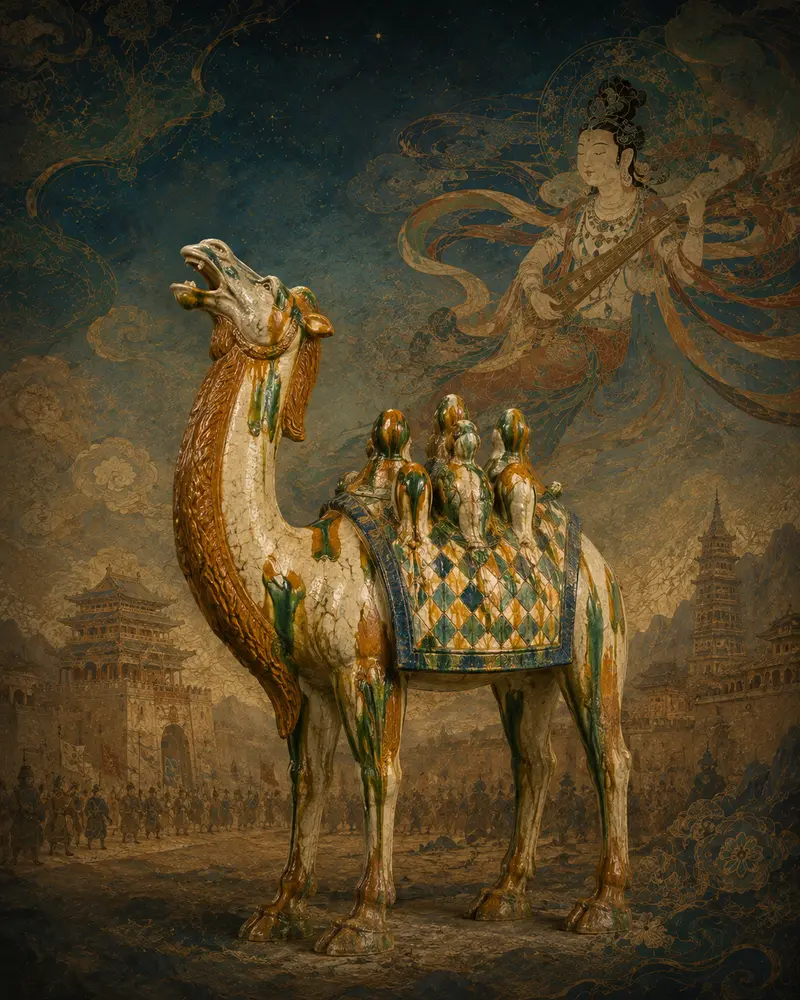



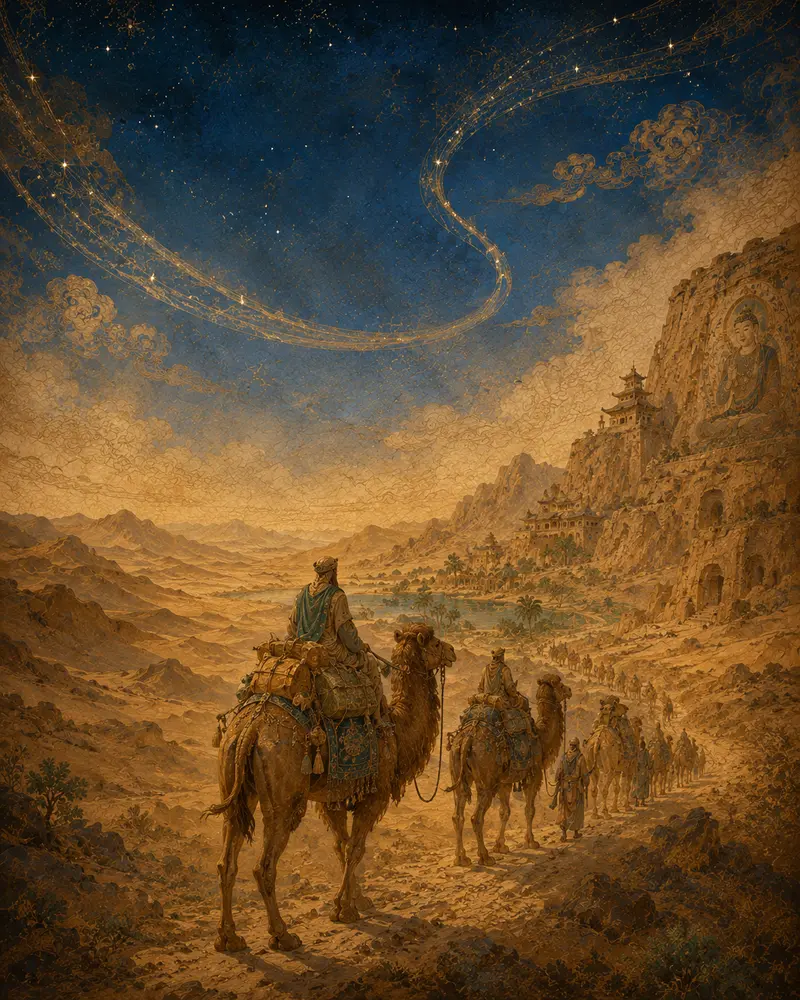
Dunhuang-inspired Silk Roads landscape with travelers, mountains, and oasis architecture

Digital History Exhibition

The Silk Roads

A Journey Across Ancient China

Follow changing networks of merchants, oasis communities, goods, beliefs, and artistic traditions across Eurasia.

Classroom reading · Recommended for Grades 6–9

Introduction · A Network, Not One Road

What Were the Silk Roads?

“Silk Roads” is a modern label for overlapping routes of trade and cultural exchange across Afro-Eurasia.

The routes shifted with politics, geography, and demand, and they included both land and sea connections. Most merchants did not travel from Chang’an to the Mediterranean. Goods usually changed hands many times.

Silk, horses, glassware, metal goods, and spices circulated through different parts of these networks. Religions, skills, and artistic traditions moved with people as well.
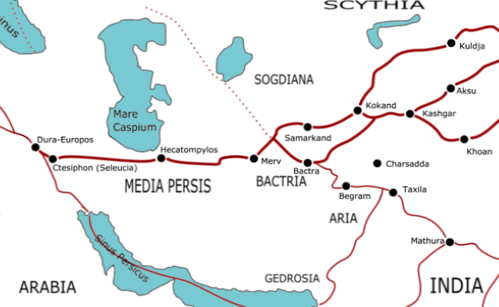
Map showing Central Asian routes within the Silk Roads network
Central Asian routes within the wider Silk Roads network

Follow the Journey

Geography shaped every exchange.

Deserts, mountain passes, river valleys, and political frontiers made a single end-to-end journey unlikely. Routes depended on stages, local knowledge, and places where travelers could rest, trade, and reorganize.

The Hexi Corridor linked the Chinese heartland with routes leading toward Central Asia. Oasis communities such as Dunhuang and Kucha were not background scenery; they were centers of exchange and cultural production.

Look closely

Where would geography slow movement, and where would a city become an essential meeting point?

Timeline · Networks in Motion

Routes changed as states, cities, and trade patterns changed.

Zhang Qian Travels West

The Han court gains more systematic knowledge of Central Asian geography and politics.

Exchange Networks Expand

Caravans, oasis cities, and middlemen connect China, Central Asia, South Asia, and the Mediterranean world.

Chang’an Becomes a Cosmopolitan Capital

The Tang capital draws merchants, faiths, and artistic traditions from Central Asia, West Asia, and beyond.

Trade Patterns Shift

Political change and expanding maritime trade reduce the relative importance of many overland routes without bringing exchange to a sudden end.

Trade & Exchange

Objects moved. Meanings changed.

Exchange was commercial, religious, artistic, and intellectual. Each transfer happened in a local context.

01

Goods in many directions

Silk, horses, glassware, metal goods, and spices circulated through different segments of the networks rather than following one fixed east–west path.

02

Religions and ideas

Buddhism entered China through these networks and took on new artistic and religious forms in different regions.

03

Skills and styles

Travelers carried languages, techniques, visual forms, and practical knowledge alongside goods.

Travelers, Merchants & Oases

The network was made by communities.

No single traveler “created” the Silk Roads. Courts, merchants, guides, translators, religious communities, and city residents all shaped how exchange worked.

TRAVELER & ENVOY

Zhang Qian

His missions gave the Han court clearer knowledge of Central Asia, though calling him the sole founder of the Silk Roads oversimplifies a much older network.

MERCHANT COMMUNITIES

Sogdian Merchants

These Central Asian traders played a major role in moving languages, religions, and goods across Eurasia.

CITIES & OASES

Dunhuang and Kucha

Oasis communities were centers of cultural production and exchange, not merely stops between more important destinations.

IMPERIAL CAPITAL

Chang’an

During the Tang, the capital drew merchants, faiths, and artistic traditions from across Asia and beyond.

Reading Primary Sources

Ask what each source can—and cannot—show.

Maps, objects, images, and written accounts need clear provenance before students treat them as historical evidence. Start by identifying who made a source, where and when it was made, and whose perspective is missing.

The interpretive artwork below provides visual entry points, not primary-source evidence. Pair it with attributed classroom sources when you build an evidence-based claim.

  1. 01

    Who created the source, and for what audience?

  2. 02

    What movement or exchange does it help us investigate?

  3. 03

    What claim would require another kind of evidence?

Classroom Connection

Teach a network problem, not a route-memorization task.

Ask students to track one product through several exchange points, then evaluate what changed each time it moved. The companion lesson turns that question into a map-led, evidence-based 45-minute sequence.